Hypotenuse AI
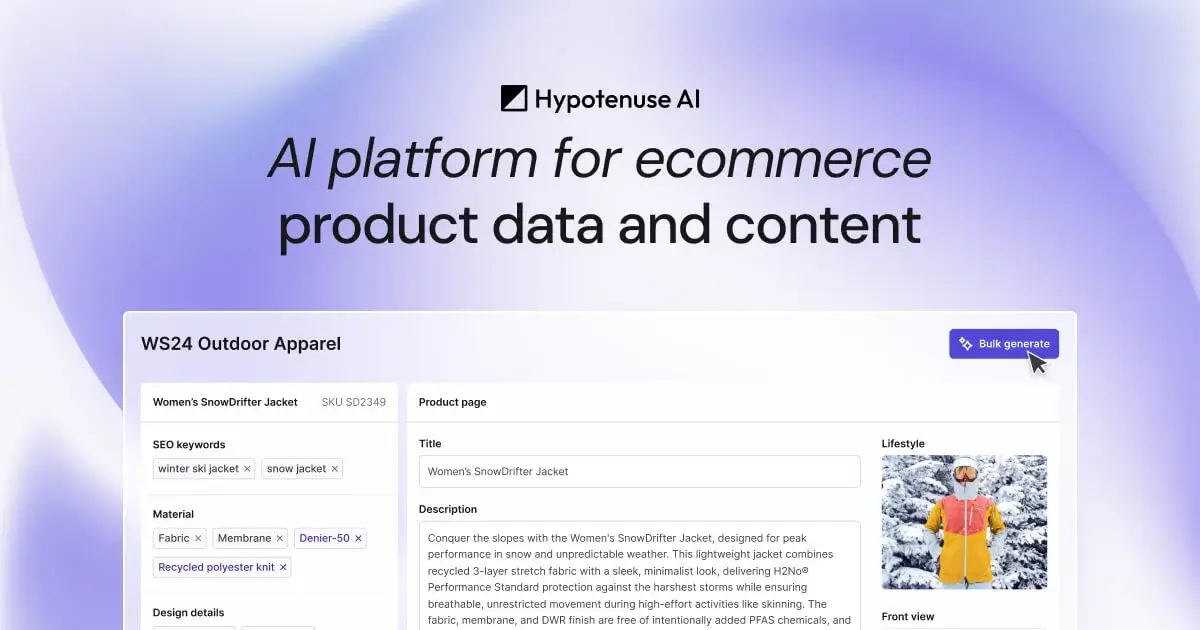
Enterprise ecommerce PXM platform for bulk product content, attribute enrichment, taxonomy, SEO/GEO copy and AI product imagery.
Evaluation
What to know
Editorial notes based on the vendor's own documentation and public pricing, plus hands-on testing where a score or review is shown above. They describe fit for a job, not absolute quality.
Best for
- Ecommerce teams onboarding hundreds of SKUs weekly
- Retailers needing consistent PDP copy and attributes at scale
- Catalog ops groups replacing patchwork freelancer pipelines
Not ideal for
- Creators writing blogs or social captions
- Startups that need instant credit-card signup pricing
- Merchants with fewer than a few hundred products
Key features
- Bulk product description and SEO/GEO content generation
- Attribute enrichment, tagging and taxonomy management
- AI product photography and bulk image editing
- 40+ language localization with brand-voice controls
- PIM/ERP/storefront integrations and enterprise governance
Pros
- Built for catalog scale instead of one-off blog posts
- Combines copy, data enrichment and imagery in one workflow
- Enterprise security/compliance story for procurement teams
Cons
- No public self-serve prices—sales cycle required
- Overkill for solo sellers with tiny catalogs
- Basic vs Enterprise packaging is opaque without a demo
ToolifyNav verdict
Hypotenuse AI is an ecommerce operations platform wearing an AI badge. List it when the buyer cares about SKU pipelines, taxonomy and compliance—not when they want a $20 writing seat. Opacity on price is expected at this tier, and the sales motion will filter casual users automatically. For serious catalog teams it is one of the clearer PXM-oriented options in Marketing. Engage Hypotenuse when SKU throughput and PXM workflows justify a sales cycle. Bypass it when you needed a $30 writer yesterday. Catalog gravity is the entire point of the Marketing listing.
About
About Hypotenuse AI
Hypotenuse AI (hypotenuse.ai) targets ecommerce catalog teams that drown in SKU content. The platform combines product description generation, meta copy, category pages, translation across 40+ languages, attribute enrichment from images or factsheets, tagging, taxonomy management and AI image editing into what it calls an AI-first PXM (product experience management) stack. Integrations with PIMs, ERPs and storefronts matter as much as the writer itself.
Pricing is sales-led. A Basic tier is listed as custom for single-seat teams getting started with descriptions and adjacent content types; Ecommerce Enterprise adds PIM-like workflows, bespoke brand models, bulk image tools, SSO-style access controls, dedicated onboarding and SOC 2 Type II claims. There is no transparent self-serve price ladder on the public page.
Hypotenuse is therefore a different animal from consumer AI writers: it assumes catalogs in the thousands to millions of SKUs and procurement processes that expect demos, not checkout links.
Implementation usually starts with a SKU pilot rather than a full catalog cutover. Attribute enrichment quality depends on source images and fact sheets; garbage inputs still yield garbage PDPs. Procurement should request security questionnaires early—Enterprise messaging leans on SOC 2 Type II and integration depth more than on a self-serve checkout.
Related
More in Marketing & Advertising
Same category — not a curated competitor list.

Discover More
Weekly digest
Get weekly AI tools and hands-on reviews
A short digest of new tools and hands-on breakdowns. Unsubscribe anytime.