Langflow
Open-source visual builder for AI agents, RAG apps, and MCP servers.
Evaluation
What to know
Editorial notes based on the vendor's own documentation and public pricing, plus hands-on testing where a score or review is shown above. They describe fit for a job, not absolute quality.
Best for
- Platform teams prototyping agentic RAG visually
- Builders exposing MCP tools or flow APIs
- Orgs that must keep orchestration self-hosted
Not ideal for
- Non-technical support teams wanting a managed helpdesk bot
- Teams unwilling to operate Docker/infra
- One-click consumer chatbot personas
Key features
- Visual flows for agents, RAG pipelines, and MCP servers
- Python-customizable components under the drag-and-drop UI
- Broad LLM, vector DB, and tool integrations
- Run, share, and expose flows as APIs
- Self-host via Docker/pip/desktop with BYO model keys
Pros
- Open-source control without locking into a single host
- Strong fit for agent graphs and MCP-style tool serving
- Deep customization path when visual nodes are insufficient
Cons
- Hosted cloud path largely gone — you own ops and uptime
- Steeper than no-code chatbot SaaS for non-engineers
- Model and infra costs still accumulate outside the free UI
ToolifyNav verdict
Langflow is the self-host visual agent canvas in this Chatbots pair: freer and more engineer-owned than CustomGPT-class hosted RAG, more graph-native than raw LangChain notebooks. Flowise overlaps heavily; Dify packages more productized LLMOps cloud options. Pick Langflow when MCP servers, transparent flows, and data residency beat managed convenience — and staff someone who can patch, back up, and monitor the deploy. Directory readers should not expect a polished forever-free cloud workspace; the product value is the open builder, not a turnkey support inbox.
About
About Langflow
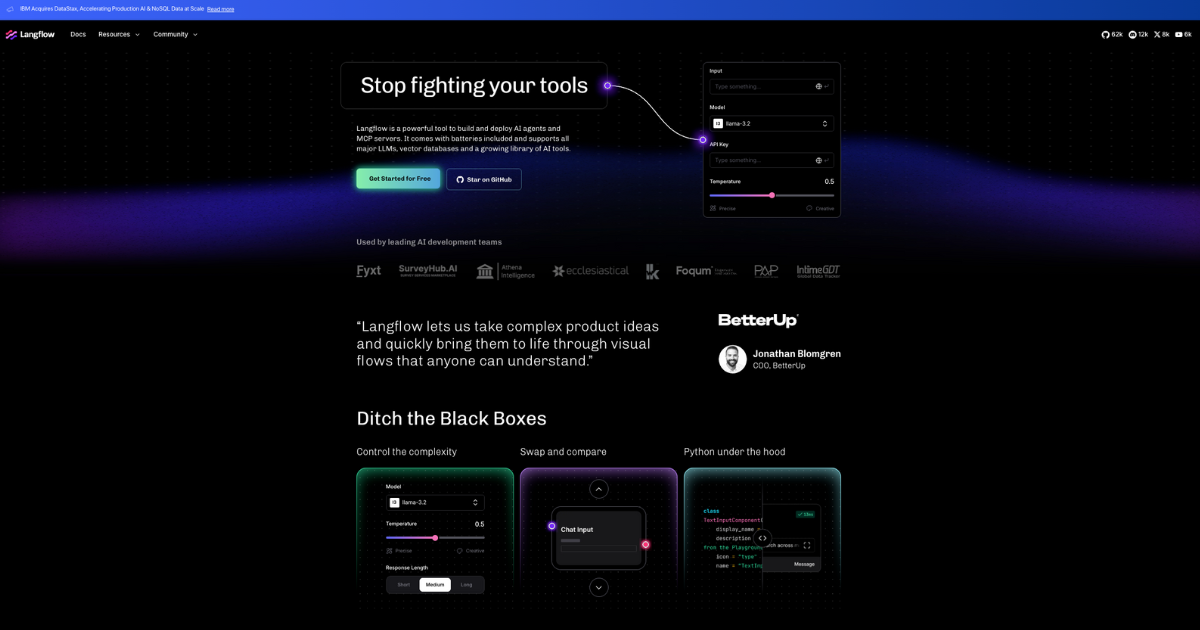
Langflow is an open-source, low-code visual builder for agentic and RAG applications. Teams drag components for models, vector stores, tools, and control flow onto a canvas, then run, share, and expose flows as APIs or MCP servers without rewriting boilerplate orchestration each sprint. The project emphasizes Python under the hood — you can customize deeply when a node is not enough — and ships with a large library of integrations across major LLMs, embeddings, and data sources.
In 2026 the managed DataStax/Langflow cloud hosting path has been discontinued according to multiple independent writeups, so most teams self-host via Docker, pip, or desktop builds and bring their own model API keys. That keeps the software free under open-source terms while shifting cost to infrastructure and token usage. IBM-related ownership/security commentary also circulates in third-party reviews; treat compliance diligence as required for enterprise installs rather than assuming a turnkey SaaS BAA.
Langflow overlaps Flowise, Dify, and notebook-to-prod frameworks. Its differentiator is the visual agent/MCP orientation for builders who want transparent graphs instead of opaque chatbot SaaS. For ToolifyNav Chatbots it belongs as an engineer-friendly orchestration layer, not a consumer persona bot.
Related
More in Chatbots & Virtual Companions
Same category — not a curated competitor list.
Discover More
Weekly digest
Get weekly AI tools and hands-on reviews
A short digest of new tools and hands-on breakdowns. Unsubscribe anytime.