Semantic Scholar
Free AI-powered academic search engine from Ai2 indexing over 200 million papers, with paper summaries, an augmented reader and an open API.
Evaluation
What to know
Best for
- Students and researchers doing literature discovery
- Developers building research tools on scholarly data
- Librarians and analysts mapping citation networks
Not ideal for
- Users wanting AI-written literature reviews
- Researchers needing paywalled full texts
- Non-academic web search
Key features
- Search across 200M+ papers from all fields of science
- Paper pages with citation and reference tracing
- Semantic Reader augmented PDF reader (select papers)
- Research feeds, library and dashboard with a free account
- Academic Graph, Recommendations and Datasets APIs with SPECTER2 embeddings
Pros
- Completely free and run by a nonprofit research institute
- Open API and datasets power a large ecosystem of research tools
- Broad cross-discipline coverage
Cons
- Interface is a search engine, not a conversational research agent
- Semantic Reader covers only select papers
- Full-text access still depends on publishers' open-access status
ToolifyNav verdict
Semantic Scholar is infrastructure more than product, and that is its appeal. A nonprofit, free search engine over more than 200 million papers, with an open API that other research startups quietly depend on, is a durable bet in a category full of credit-metered agents. It does not write your literature review or chat about results; it finds, organizes and connects papers, with Semantic Reader adding helpful context on supported titles. Researchers should keep it as a primary discovery layer and pair it with a synthesis tool if they want summaries. Developers should look at the API before paying for any scholarly data feed.
About
About Semantic Scholar
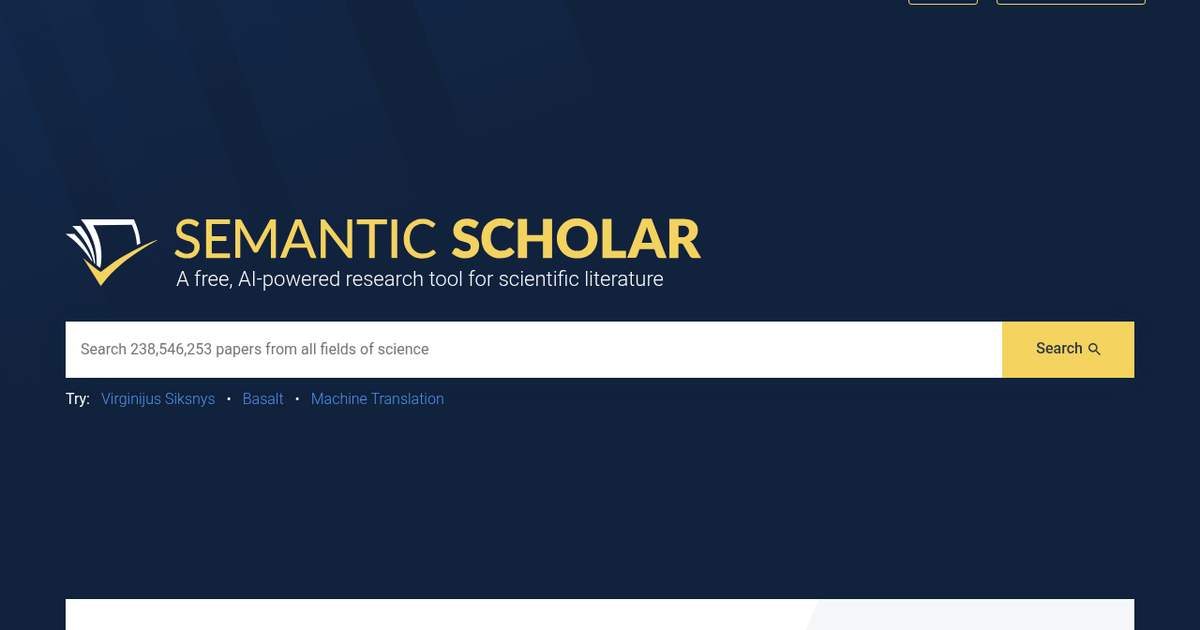
Semantic Scholar is a free research discovery tool built by the Allen Institute for AI (Ai2), a nonprofit. It indexes more than 200 million academic papers — the homepage counter currently shows over 238 million — gathered from publisher partnerships, data providers and web crawls across every field of science.
Its in-house models process and classify papers so researchers can understand them at a glance. Search results surface extracted metadata and connections between works, and individual paper pages expose citations and references so you can trace how ideas spread. Semantic Reader, an augmented PDF reader available for select papers, adds in-context explanations and makes citations clickable without losing your place. Free accounts unlock a research dashboard, personalized research feeds and a library for saving papers.
Semantic Scholar matters beyond its own interface because of its data. The Academic Graph API provides authors, papers, citations, venues and SPECTER2 embeddings; a Recommendations API suggests similar papers; and a Datasets service offers bulk downloads. Ai2 publishes the open data platform paper behind it. Several tools already listed on ToolifyNav, including Connected Papers and Litmaps, are built on top of Semantic Scholar's corpus and APIs.
As a nonprofit project, Semantic Scholar positions itself around equal access to science. There is no paid tier; API access requires requesting a key for higher limits.
Related
More in Research & Data Analysis
Same category — not a curated competitor list.
Discover More
Weekly digest
Get weekly AI tools + hands-on reviews
A short digest of new tools and hands-on breakdowns — unsubscribe anytime.