Zed
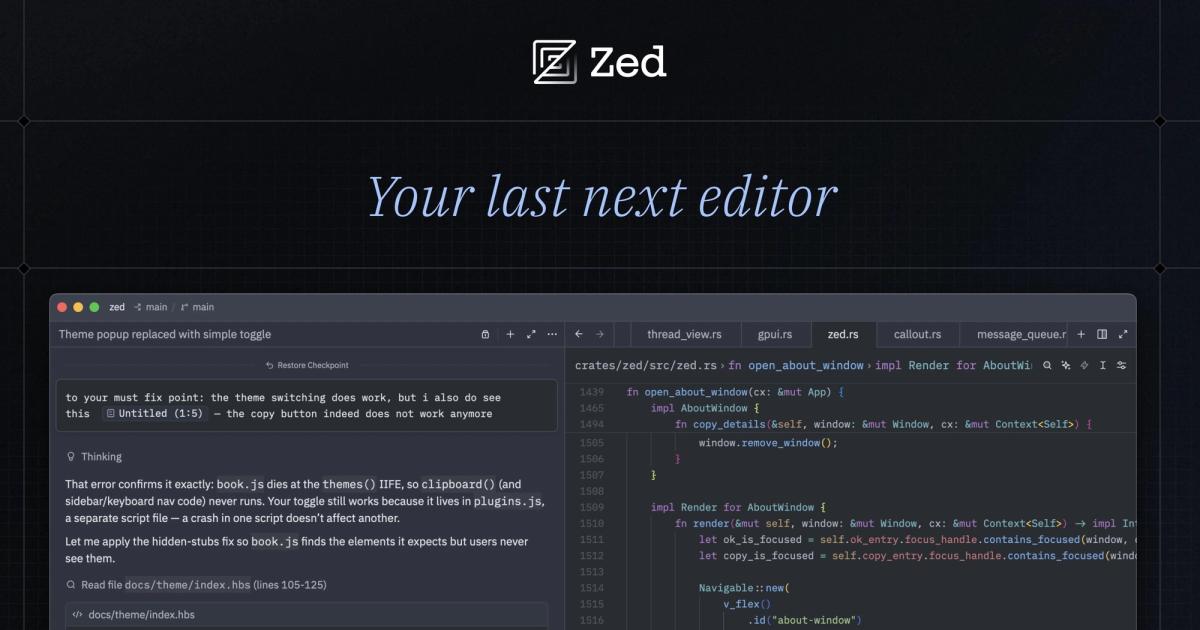
Rust-built, GPU-rendered code editor with real-time collaboration, native agent editing, and open edit-prediction model.
Evaluation
What to know
Best for
- Developers who value editor speed and low latency
- Teams pairing remotely inside the editor
- Engineers who want to switch between multiple coding agents
Not ideal for
- Workflows dependent on niche VS Code or JetBrains extensions
- Enterprises requiring SSO today
- Users who prefer a fully managed, no-config AI IDE
Key features
- Native Rust editor with GPU rendering on macOS, Linux and Windows
- Built-in multiplayer: shared projects, follow mode, chat and screen share
- Agent panel with editable unified diffs and granular tool permissions
- ACP support for Claude Agent, Codex CLI, OpenCode plus MCP servers
- Zeta open-weight edit predictions; hosted, local (Ollama) or BYOK models
Pros
- Very fast and lightweight compared with Electron-based editors
- Agent-agnostic: bring external agents instead of being locked in
- Free plan is fully usable with your own keys
Cons
- Extension ecosystem is smaller than VS Code's
- SSO, SAML and SCIM are planned but not yet available for Business
- Hosted usage is billed at API list price plus 10% beyond included credit
ToolifyNav verdict
Zed's pitch is that an AI editor should still be a great editor first, and the Rust core delivers on that: it opens fast, stays responsive with large projects, and treats collaboration as a native feature. The more strategic choice is openness. ACP lets developers run Claude Agent or Codex inside Zed rather than accepting a single vendor's agent, Zeta is open-weight, and the free tier works with your own keys. What holds it back is ecosystem depth and enterprise plumbing; heavy extension users and SSO-mandated companies will hit gaps. For speed-sensitive developers it is a strong daily driver.
About
About Zed
Zed is an open-source code editor written from scratch in Rust by the team that previously built Atom. It uses multiple CPU cores and the GPU for rendering, which is where its reputation for speed comes from, and it runs on macOS, Linux and Windows. Collaboration is built in rather than bolted on: teammates can chat, share a project, follow each other's cursors and pair inside the editor.
AI features sit on the same foundation. Agentic editing lets you describe a task and watch the agent discover context, edit files and run tools, then review everything in an editable unified diff before accepting. Through the Agent Client Protocol (ACP) — an open protocol Zed created — you can plug in external agents such as Claude Agent, Codex CLI or OpenCode instead of Zed's own, and MCP servers extend what any agent can see. Tool permissions are configurable at a granular level.
Edit predictions come from Zeta, Zed's open-weight, open-data model that predicts your next edit as you type. Models can be Zed-hosted, run locally through Ollama, or accessed with your own API keys from Anthropic, OpenAI, Google and others. The free Personal plan covers the editor with a monthly cap on accepted predictions and unlimited use of your own keys or external agents; Pro adds hosted models and unlimited predictions, while Business layers org-wide AI policies, data controls and unified billing on top.
Related
More in Coding & Development
Same category — not a curated competitor list.


Discover More
Weekly digest
Get weekly AI tools + hands-on reviews
A short digest of new tools and hands-on breakdowns — unsubscribe anytime.