Zencoder
Multi-model coding agent platform whose Zenflow desktop app plans with one model, builds with another and reviews with a third, running quality gates on every change.
Evaluation
What to know
Editorial notes based on the vendor's own documentation and public pricing, plus hands-on testing where a score or review is shown above. They describe fit for a job, not absolute quality.
Best for
- Engineering teams wanting structured, reviewable agent output
- Engineering managers automating recurring maintenance
- Organizations working across many repositories
Not ideal for
- Solo developers who mainly want autocomplete
- Budget-constrained students
- Teams that insist on an open-source, self-hosted agent
Key features
- Spec-first workflows that plan, build and verify with different frontier models
- Parallel agents in isolated environments across repositories
- Built-in quality gates running tests, linting and cross-agent review
- Scheduled automations for triage, PR review and dependency updates
- Zenflow Work agents connected to Jira, Slack, Notion and Gmail
Pros
- Cross-model review catches mistakes a single model tends to repeat
- One subscription reaches Claude, Gemini and OpenAI models
- Org-wide credit pool with per-user caps suits teams
Cons
- Seats start at $40-45 a month, a lot for hobbyists
- Unused plan credits expire at the end of each month
- The orchestration approach feels heavy next to a simple inline assistant
ToolifyNav verdict
Zencoder's bet is that the best results come from making models check each other, and Zenflow's plan-build-review pipeline turns that idea into a repeatable process. For teams, the appeal is less raw speed than predictability: specs, isolated runs and automatic tests produce changes that are easier to trust and review. The cost of that structure is real, with per-seat pricing that assumes professional use and a workflow that feels heavy for a quick script. Engineering groups already struggling to review agent output at volume are the natural audience for this platform.
About
About Zencoder
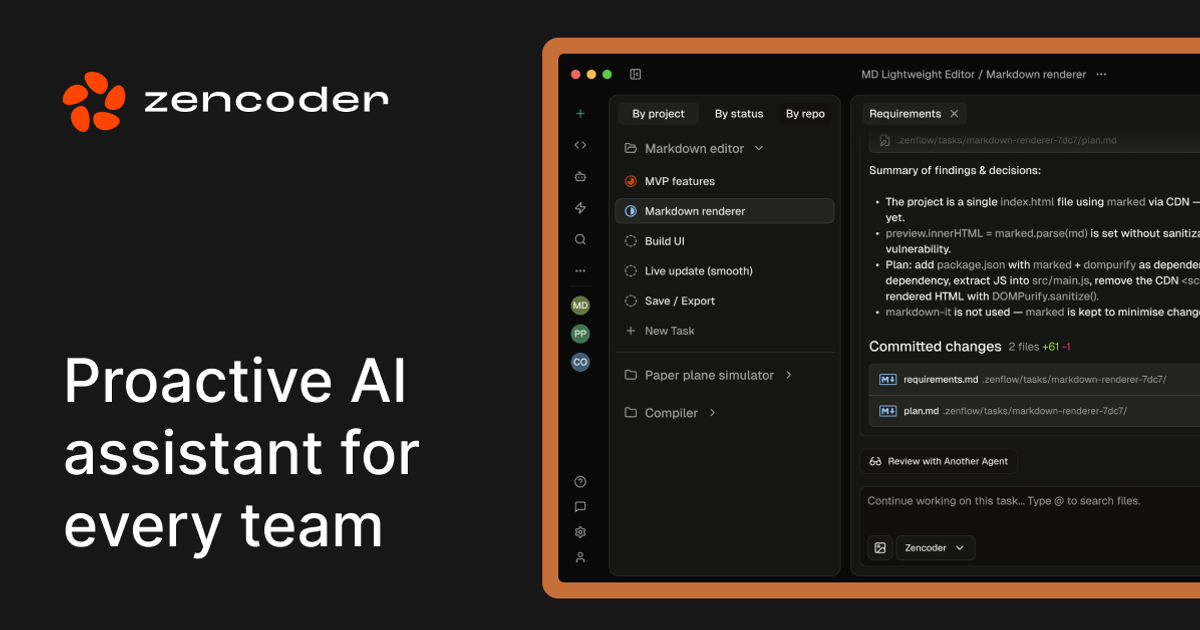
Zencoder has repositioned from an IDE coding plugin into what it calls AI orchestration for code and work. The centerpiece is Zenflow, a desktop app with IDE plugins and CI/CD hooks that runs spec-driven workflows: a reasoning model drafts a specification with architecture decisions and acceptance criteria, a faster model implements it, and a different model reviews the result. Zencoder's own example pairs Claude Opus for planning, Gemini for building and OpenAI Codex for review.
Each agent works in an isolated environment, so dozens can run in parallel across files, modules and repositories. Tests, linting and code review run on every change before a human looks at it. Pre-built workflows cover features, bug fixes and refactors, and you can define your own. Scheduled automation handles chores such as daily bug triage, pull-request reviews and dependency updates, while multi-repo indexing and dependency mapping give agents context before they edit anything.
A second app, Zenflow Work, applies the same orchestration to non-code tasks across Jira, Slack, Notion, Gmail and more than 2,000 other integrations. Pricing is per seat with a monthly credit grant; paid plans pool credits across an organization with per-user caps, and calls made with your own API keys do not consume credits.
Related
More in Coding & Development
Same category — not a curated competitor list.
Discover More
Weekly digest
Get weekly AI tools and hands-on reviews
A short digest of new tools and hands-on breakdowns. Unsubscribe anytime.