Deepnote
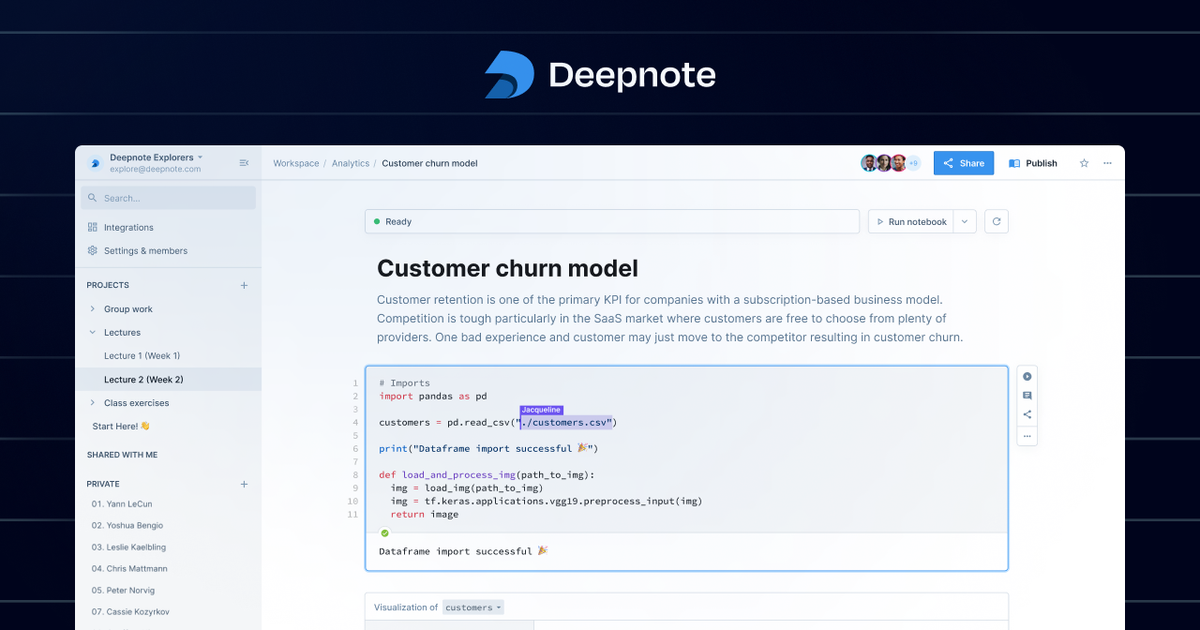
Collaborative cloud data notebook for Python and SQL with an AI agent, data apps, scheduling and integrations to major warehouses.
Evaluation
What to know
Editorial notes based on the vendor's own documentation and public pricing, plus hands-on testing where a score or review is shown above. They describe fit for a job, not absolute quality.
Best for
- Data science teams collaborating on notebooks
- Analysts sharing scheduled reports and data apps
- Educators and students running notebooks without setup
Not ideal for
- Users who require fully offline local notebooks
- Organizations standardized on Databricks for all workloads
- Non-technical teams wanting pure drag-and-drop BI
Key features
- Real-time collaborative Python and SQL notebooks in the browser
- Deepnote AI agent that plans, writes, runs and fixes analysis
- Scheduling, alerts and ETL pipelines from notebooks
- Data apps and dashboards for non-technical stakeholders
- Integrations with major warehouses, Spark, GPUs and SOC 2/HIPAA controls
Pros
- Jupyter familiarity with far better team collaboration
- Free plan is workable for small teams
- AI agent operates with notebook and data context
Cons
- AI usage is limited on the free tier
- Compute-heavy work adds machine costs beyond seats
- Teams with entrenched local Jupyter setups face migration effort
ToolifyNav verdict
Deepnote is a natural upgrade for teams who like Jupyter but struggle with sharing, environment setup and scheduled reporting. Real-time collaboration, warehouse integrations, an AI agent that works within notebook context, and publishable data apps cover most day-to-day analytics needs in one browser tab. Costs rise with editors and compute, and heavy Databricks shops may not need another layer. For data science and analytics teams that want collaborative notebooks with sensible governance, it is one of the most rounded options, and the free tier lowers the barrier to evaluation.
About
About Deepnote
Deepnote is a cloud data notebook that rethinks Jupyter for teams. Notebooks run in the browser with real-time collaboration, comments and version history, and combine Python, SQL and no-code blocks such as charts, inputs and big-number KPIs. Native integrations connect to Snowflake, BigQuery, Postgres, Databricks, S3 and dozens of other sources, and notebooks can be scheduled to refresh data, send alerts or run ETL/ELT jobs.
Deepnote AI provides an agent that can plan an analysis, write and run code blocks, fix errors and summarize findings, using the notebook's context and connected data. Results can be published as data apps and dashboards for non-technical colleagues. The platform also supports a semantic layer through modules, LookML and dbt, a data catalog, Spark and Snowpark, machine-learning training and model serving from notebooks, and GPU machines for heavy workloads.
Security credentials include SOC 2 and HIPAA support for regulated industries. Deepnote reports more than 600,000 data professionals using the product and maintains comparison pages against Jupyter, Google Colab, Databricks and SageMaker. A free plan suits individuals and small teams, with paid tiers for more editors, compute and governance.
Related
More in Research & Data Analysis
Same category — not a curated competitor list.
Discover More
Weekly digest
Get weekly AI tools and hands-on reviews
A short digest of new tools and hands-on breakdowns. Unsubscribe anytime.