Consensus Review: 4/5 — Fast Evidence Meters and Cited Papers, Gated by Signup
I ran a falsifiable intermittent-fasting question through Consensus: email signup, ~13s Pro synthesis, Consensus Meter N=20, Study Snapshot, then Free vs Pro pricing. Final rating: 4 out of 5.
I used Consensus on a falsifiable science question and got a cited meter plus paper cards in about 13 seconds after email signup. Final rating: 4 out of 5. Directory page: Consensus on ToolifyNav. Official site: consensus.app.
Most AI search tools answer science questions by summarizing whatever ranks on the open web. I wanted something narrower. Take one outcome-specific question, land on peer-reviewed studies, and see whether the product gives me an evidence trail I can actually inspect.
The query I ran on 9 September 2026 (about 09:06 Asia/Shanghai): “Does intermittent fasting improve insulin sensitivity in adults?”
Getting in: the email wall
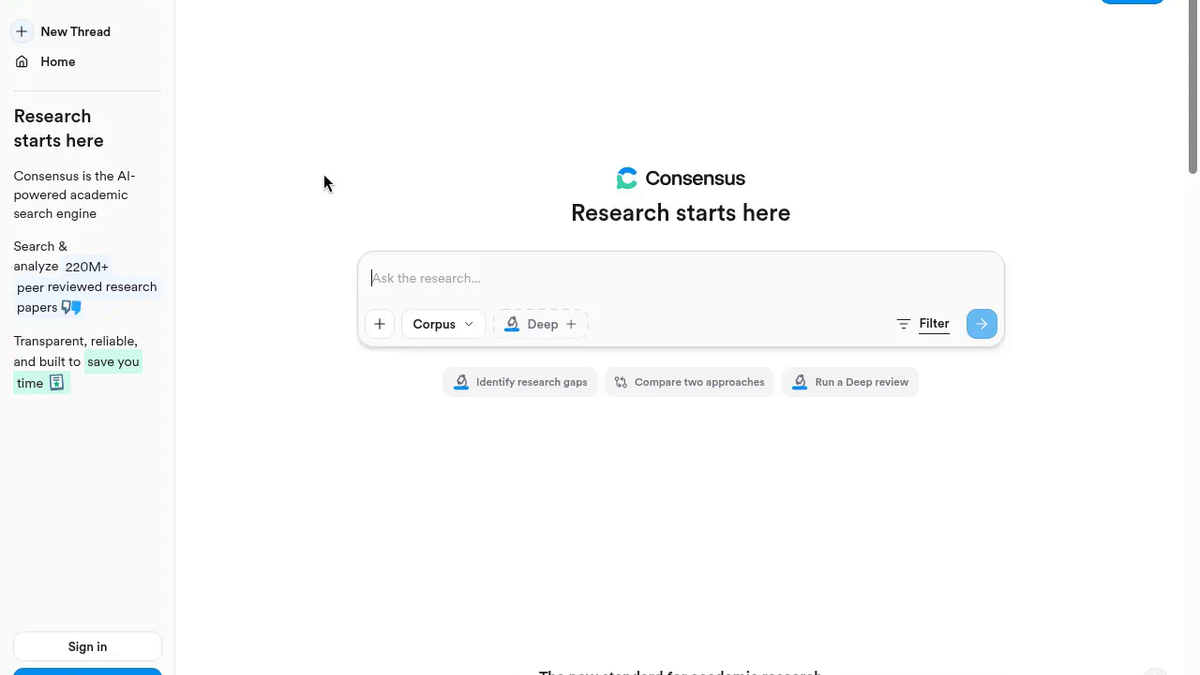
Homepage copy was clean: “Research starts here,” “Consensus is the AI-powered academic search engine,” “Search & analyze 220M+ peer reviewed research papers,” plus “Transparent, reliable, and built to save you time.” Quick chips for “Find promising research questions,” “Search with filters,” and “Find the Consensus.” Search placeholder: “Ask the research...” Controls: Corpus, Deep +, Filter. No cookie banner.
I typed the question and hit submit, expecting at least a peek at results. Instead I got an auth screen: “Enter your email,” “Continue with Google,” “Continue with Apple.” No anonymous preview.
I skipped Google and Apple, entered no password and no card, and used the review Hotmail. Outlook showed a Consensus message with a 6-digit verification subject. After the code, onboarding asked “Which best describes you?” (I picked Other), “Bring your research with you!” (I’ll do this later), then “Ask research questions. Get cited answers.” (Ask my own). Sidebar allowance on entry: “5 / 5 Pro messages left.”
The search: 13 seconds to a Consensus Meter
I ran the same query again in the Corpus / Pro flow.
- About 5 seconds in: loading / scanning.
- About 13 seconds in: synthesis, Consensus Meter, and paper cards filled in.
Top of results showed “Results 52.3K.” The Pro step also said “Read Abstracts and PDFs 20.” I treat 52.3K as the displayed pool, not papers I personally read.
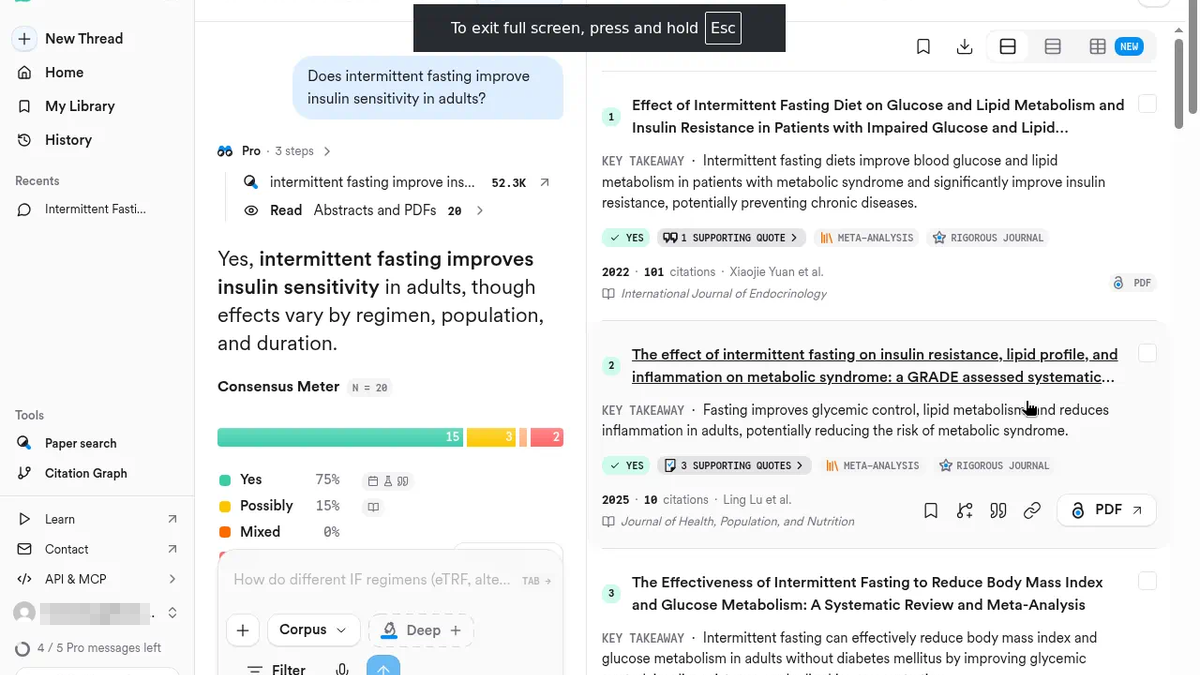
AI synthesis, verbatim: “Yes, intermittent fasting improves insulin sensitivity in adults, though effects vary by regimen, population, and duration.”
Consensus Meter N = 20: Yes 15 (75%), Possibly 3 (15%), Mixed 0, and a red segment of 2. The red legend text sat below the fold, so I am not naming that label beyond the visible 2/20 count.
Cards showed titles, years, authors, citation counts, journals, supporting-quote counts, methodology / journal badges, and PDF buttons, with a References pane. First cards included the Yuan et al. systematic review / meta-analysis on intermittent fasting and glucose / lipid metabolism, and a GRADE-assessed systematic review on insulin resistance, lipid profile, and inflammation in metabolic syndrome.
That combination — meter plus inspectable cards — is what made the question feel testable instead of chatty.
Paper detail and Study Snapshot
I opened the first paper. Overview: 24 March 2022; International Journal of Endocrinology; Q3 SJR; 101 citations; 3 influential; DOI 10.1155/2022/6999907. The abstract described a systematic review of clinical trials using random-effects or fixed-effect models. Visible outcomes included fasting blood glucose −0.15 mmol/L, glycated hemoglobin −0.08, insulin plasma −13.25 uIU, HOMA-IR −0.31, BMI −0.8 kg/m², body weight −1.07 kg, and waist circumference −2.08 cm, with confidence intervals in the UI. Tabs included Attachment, Evidence (1), Metadata, plus link/copy and download icons. I did not open the PDF.
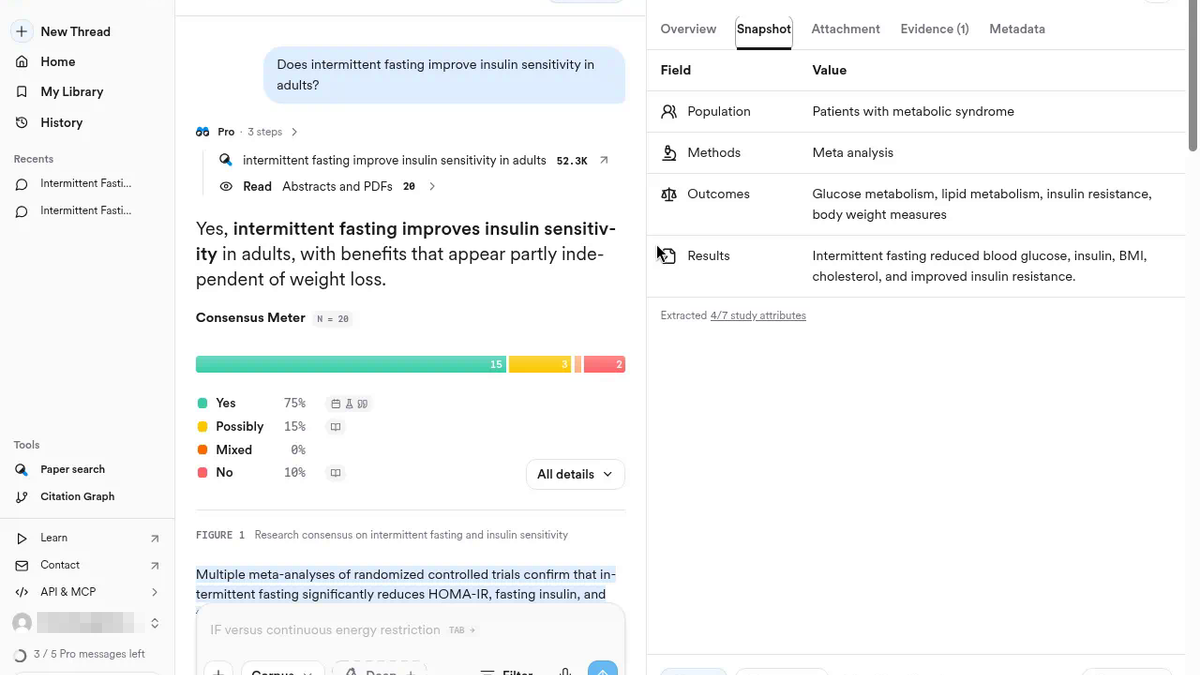
Generating Study Snapshot showed “10 Study Snapshots left” and “You have 10 Study Snapshots left — you will get 10 more on October 8th. Upgrade to Pro for unlimited Snapshots, Pro Analysis, and more.” Fields returned:
- Population: Patients with metabolic syndrome
- Methods: Meta analysis
- Outcomes: Glucose metabolism, lipid metabolism, insulin resistance, body weight measures
- Results: Intermittent fasting reduced blood glucose, insulin, BMI, cholesterol, and improved insulin resistance.
- Badge: “Extracted 4/7 study attributes”
Fast and concrete. Also visibly partial.
Filter edit and allowance counters
I opened Filter, chose “Past 5 yrs” under Publish year. Range became 2021 — 2026, UI showed “Filter (2)” and “Apply 2 filters.” Open access and Exclude Preprints stayed untouched. After apply, the headline still read “Results 52.3K.” The filtered total never became obvious.
After the one Pro search, sidebar moved from “5 / 5 Pro messages left” to “4 / 5 Pro messages left.”
Pricing observed
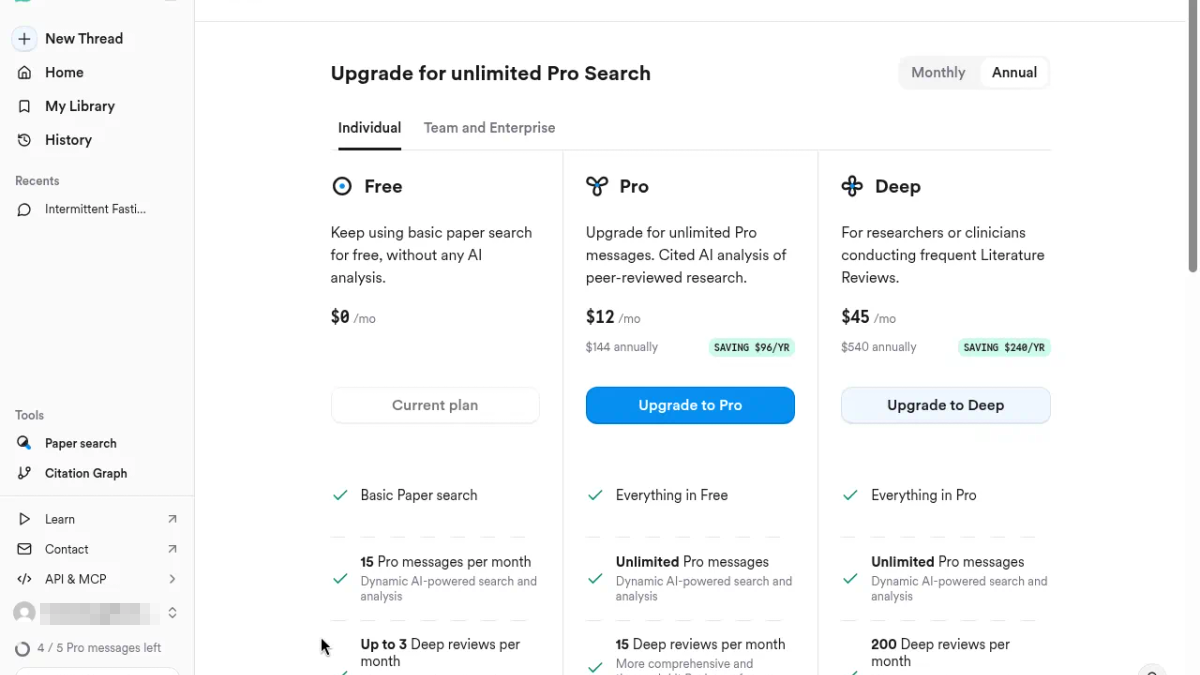
Individual / Annual pricing page:
- Free — $0/mo. “Keep using basic paper search for free, without any AI analysis.” Basic Paper search; 15 Pro messages per month; up to 3 Deep reviews per month.
- Pro — $12/mo ($144 annual, “SAVING $96/YR”). Unlimited Pro messages; 15 Deep reviews per month.
- Deep — $45/mo ($540 annual, “SAVING $240/YR”). Unlimited Pro messages; 200 Deep reviews per month.
I did not pay. I also did not invent an explanation for this mismatch: pricing copy says 15 Pro messages/month on Free, while my new account sidebar started at 5 / 5 and dropped to 4 / 5 after one search.
What worked / what kept it from a 5/5
What worked: a 13-second Pro synthesis with a 20-paper meter; paper cards with DOIs and effect sizes in the UI; Study Snapshot structured in seconds.
What kept it from a 5/5 were the hard email wall before any results, the filter that left “Results 52.3K” unchanged, the snapshot stopping at 4/7 attributes, and the Free-plan 15 vs sidebar 5 Pro-message mismatch.
Not tested
Not tested: anonymous results (blocked by signup), Google / Apple / password login, Deep review, Ask Paper, PDF download/open, Citation Graph, API / MCP, Team / Enterprise, monthly billing toggle, payment, Open access filter, Exclude Preprints.
No assumption: 52.3K is not “papers analyzed”; the red meter label beyond the visible 2/20 segment; that the year filter changed the 52.3K headline; that 4/7 snapshot fields are complete.
Who it’s for
Students, clinicians, and researchers who already have a specific scientific question and want a rapid cited consensus check with abstract-level evidence, not a generic chatbot summary.
Verdict
Consensus turned my intermittent-fasting question into a measurable trail — meter, 20 abstracts, DOI-backed cards, and a snapshot — in one sitting on the free tier. Signup before search, sticky headline counts, partial snapshots, and the Pro-message allowance mismatch are why it stays a 4 for me. The full Consensus review lives with the ToolifyNav listing.
Final rating: 4 out of 5.
Sources: https://toolifynav.com/item/consensus (official website, verified during review).
ToolifyNav Directory
Explore Consensus on ToolifyNav
Ask a falsifiable science question and meet studies, not listicles.
Keep Reading
Related posts
AI Tool Reviews
Felo Review: 4/5 — Anonymous Search Nailed a Chile Trap, Signup Hit an Image Captcha
Anonymous Felo search answered a three-part Argentina fact check in about 21 seconds, caught the Aconcagua-in-Chile trap, and rewrote the answer in Spanish with citations kept. Signup stopped on an image captcha. Final rating: 4 out of 5.
AI Tool Reviews
ChatPDF Review: A Trap Question, a Missing Citation and a Fair Free Tier (4/5)
I wrote a two-page darkroom handbook, hid a trap question in it and asked ChatPDF's free tier four questions. It got all four right and refused to invent a price, but one cross-page answer cited the wrong page for half its maths.
AI Tool Reviews
Cleanup.pictures Review: Fast Inpainting Behind a 720p Gate (4/5)
Cleanup.pictures let me wipe SAMPLE WATERMARK, FOR SALE — DEMO, and REMOVE ME off a watch photo in about six seconds of server time — then handed back a 720×523 free download with the HD gate spelled out up front.