Diffit Review: A Useful Worksheet in Seconds, but a 404 Became a Lesson (3/5)
Diffit turned my temperature notes into a correct grade-five worksheet, then rewrote it for grade two without losing the numbers. But it also invented classroom details and generated a polished lesson from a URL that returned 404, so the output needs a teacher’s source check.
I gave Diffit a tiny set of class notes and one annoying rule: use only these facts. The notes had four temperatures, one observation about dark surfaces, and one about water evaporating from leaves. I wanted a grade-five reading passage, five comprehension questions, an answer key, and two subtraction problems. Small enough that I could check every line without guessing.
Signing up was ordinary in a good way. I used email and a verification code, chose classroom teacher, picked grades and science, then skipped the optional colleague invitations. No card. The account opened with a Premium trial; once I reached a resource, Diffit told me there were 13 days left. That badge matters because some of the export buttons I saw are not part of the permanent free plan.
The first worksheet was ready before I had cleaned up my notes
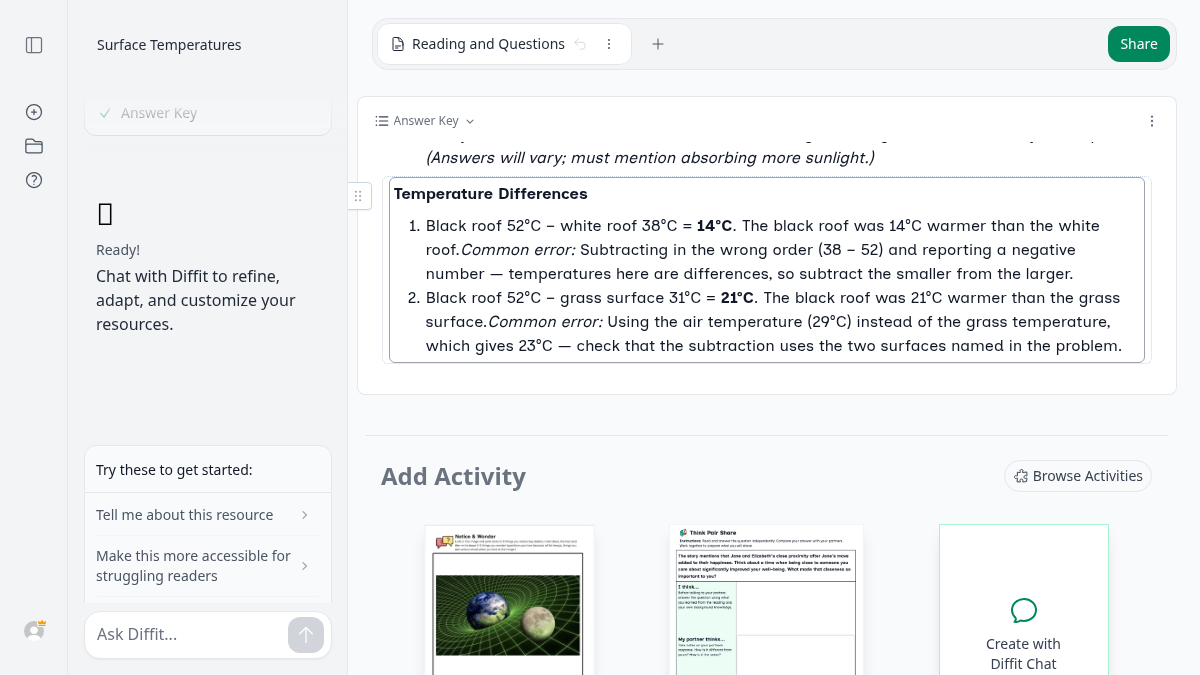
The first draft appeared within about half a minute. It had the passage I asked for, three multiple-choice questions, two written questions, the two temperature-difference problems, and a separate answer key. The arithmetic was right: 52°C minus 38°C gave 14°C, and 52°C minus 31°C gave 21°C. It even added likely mistakes under each answer, including what happens if a student subtracts in the wrong order or accidentally uses the 29°C air temperature. Those little notes felt like something a teacher would actually use while marking work.
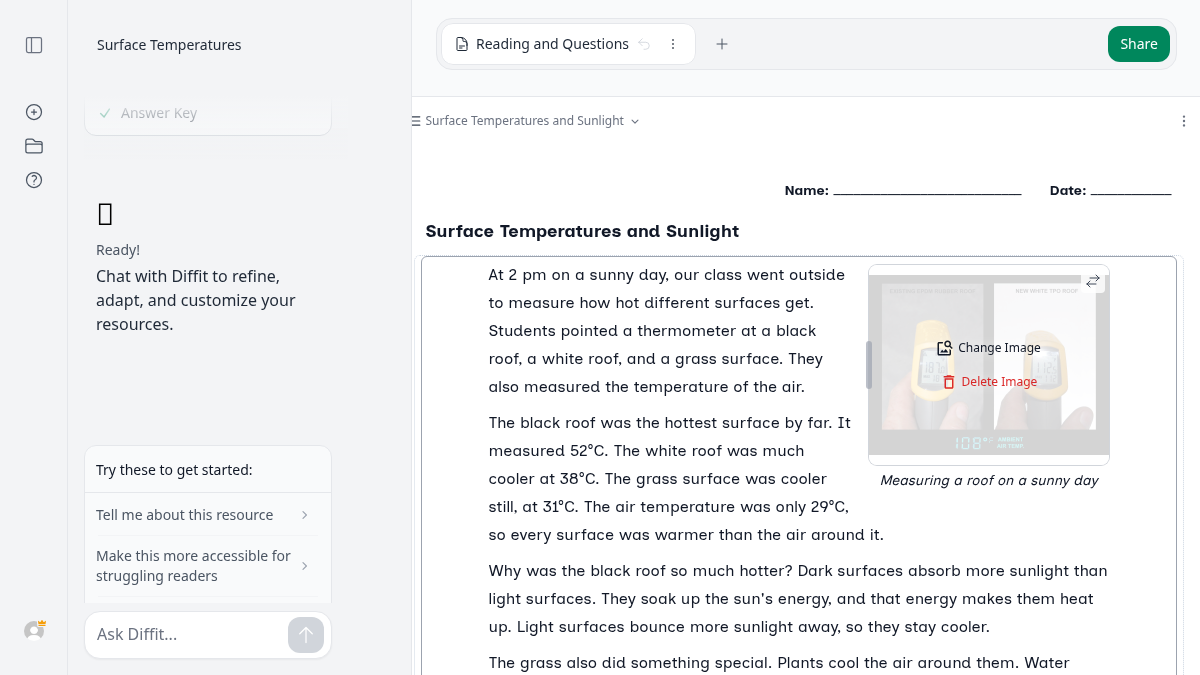
The questions also paid attention to a useful trap. Every measured surface was warmer than the 29°C air, including the 31°C grass, so the correct answer to “Which surface was cooler than the air?” was “None of them.” I had put that 29°C figure in specifically to see whether it would treat grass as automatically cooler than air. It did not fall for it.
It also crossed the source boundary I had set
My notes did not say that a class went outside or that anyone pointed a thermometer. Diffit wrote both. It also added an explanation about light surfaces bouncing sunlight away, despite my “based only on these class notes” instruction. These are plausible additions, not wild hallucinations, but that is almost the problem: they sit comfortably inside an otherwise clean worksheet and are easy to miss.
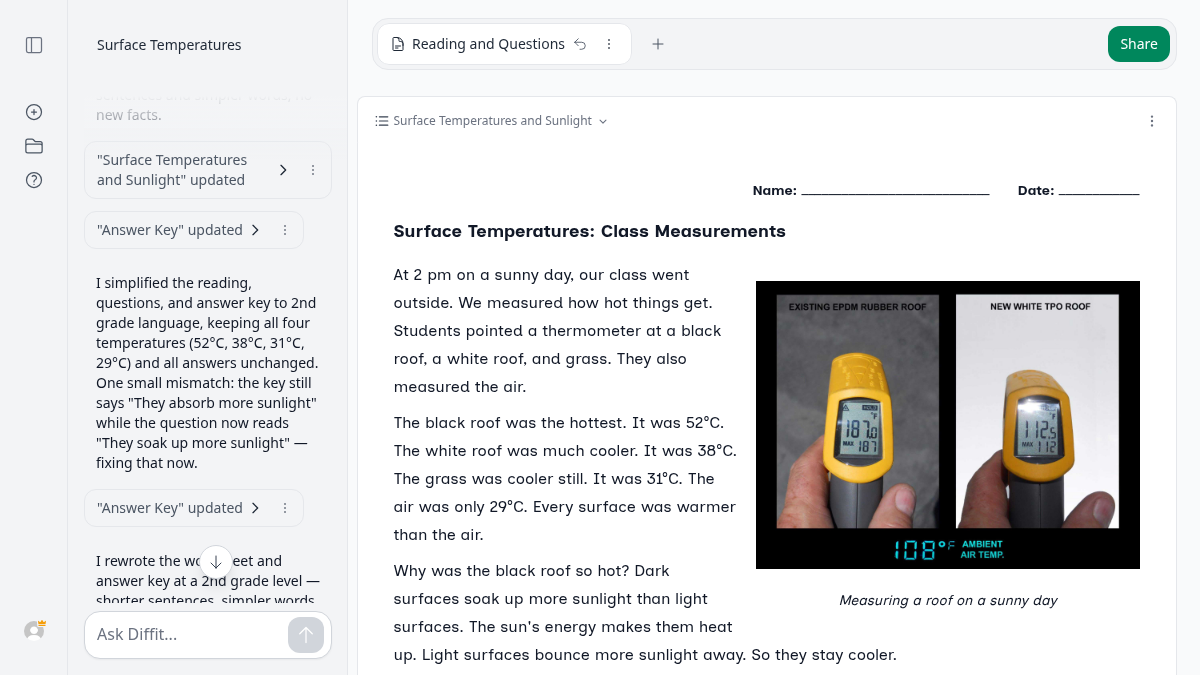
The automatic image was worse. It showed thermometer readings of 108°F and 112.5°F beside a passage about 52°C, 38°C, and 31°C. Different numbers, different units. I could delete or replace the image in the editor, but I would not want that visual going home with students just because the text checked out.
The grade-two rewrite did the part I cared about
Next I asked the built-in chat to rewrite the same resource for grade two, keep all four temperatures and the answer key, shorten the sentences, and add no facts. About a minute later it had rewritten both the worksheet and key in place. The passage went from 161 words to 142, while the sentence count rose from 16 to 22. That is the kind of change I wanted: less packed into each sentence, not merely smaller vocabulary swapped into the same structure.
All four temperatures survived, and both calculations stayed correct. Diffit even noticed that it had changed “absorb” in a question to “soak up” while the key still used the old wording, then made another update to align them. I appreciated that little self-correction. It still kept the invented trip outside and the added light-surface explanation, though. Simplifying a draft is not the same as cleaning its sources.
There was one new wording wobble too: the grade-two passage said “Water dries off their leaves,” while the sample answer still said water “evaporates.” Not a disaster, but another reason I read the student page and the key together.
Editing is direct, and the free PDF actually downloaded
I clicked into the title and changed it to “Surface Temperatures: Class Measurements.” A small formatting toolbar appeared, Undo became available, and my title survived the later AI rewrite. That editing loop felt unusually straightforward for an AI generator: the result is not a frozen preview that has to be exported before I can fix it.
The Download PDF button produced a 787,810-byte file without sending me to checkout. Google Docs, Slides, Forms, Classroom, Canva, and Microsoft Word all carried Premium crowns in the export area. On the public plan page, Basic includes resource creation, editing and differentiation, PDF, printing and sharing; it also says resources are available for the last 90 days. Individual Premium was listed at $14.99 monthly or $149.99 yearly for US customers, with Google, Canva and Microsoft exports, standards and curriculum alignment, complete resource history, and more customization on the paid side. School pricing requires a quote.
Because my account was inside the trial, I am not claiming a post-trial test of every Basic feature. The PDF download, inline editing and chat adaptation are things I really did. The 90-day history limit and plan boundaries are what Diffit displayed on its pricing pages, not something I waited 90 days to verify.
The broken-link test is why I would not hand it a source and walk away
For the last run, I gave Diffit a URL at example.com that returned 404. I asked for a grade-five passage and three questions using only that page, and explicitly told it to tell me if the page could not be read instead of making a worksheet. A real reading tool has an easy decision there: stop and show the fetch problem.
Diffit made a worksheet called “Understanding Example Domains.” Three paragraphs, three questions, answer key, and a “Ready!” message. It discussed documentation examples, avoiding the domain for testing or monitoring, and translations in several languages. Then it printed the nonexistent URL after the word “Source.” I stared at that line for a second because the page looks completely finished. There was no warning in the resource that the address itself had failed.
This was not one wrong date inside an otherwise valid source summary. There was no source page at that address. Perhaps the fetch fell back to example.com’s root content; the resource does not explain what happened, and I am not going to invent a mechanism for it. What I can say is that my explicit failure instruction was ignored and the resulting worksheet gave no usable warning.
I would still open Diffit when I already have the notes or text in front of me and need a first classroom draft quickly. The leveled rewrite and editable answer key saved real work in this test. I would paste the source, remove the automatic image unless it fits, and check both the student page and key before exporting. I would not use a URL as proof that the resulting lesson is grounded.
I did not test file uploads, Google or Microsoft exports, standards alignment, school administration, or classroom sharing with students. I also did not run a full subject-matter review across science, math and history; this was one controlled temperature exercise, one grade adaptation, one PDF export, and one deliberately broken source.
Final rating: 3/5. The worksheet builder is quick and genuinely editable, but the confident 404 result means the polish cannot double as a source check. I keep the ToolifyNav listing updated if the pricing changes.
ToolifyNav Directory
Explore Diffit on ToolifyNav
AI for teachers — adapt any text into leveled readings, questions, and classroom activities.
Keep Reading
Related posts
SaaS Reviews
Auphonic Review: -24.47 to -16.00 LUFS in Seconds, but Free Exports Get a Jingle (4/5)
I fed Auphonic a 25.56-second speech file with uneven levels, white noise, and hum. It hit -16.00 LUFS exactly and varied the leveler gain by section, but the free MP3 grew by 6.408 seconds because Auphonic appends a jingle.
SaaS Reviews
Knowt Review: A 2-Page PDF Became a Clean Study Guide in 30 Seconds, but Flashcards Are Behind the Paywall (3/5)
Knowt's AI PDF Summarizer turned a two-page PDF I wrote myself into a structured nine-section study guide in about 30 seconds, and stayed faithful to my source. The note body leaks raw LaTeX into doubled numbers, the word count is wrong, and Flashcards from the same PDF are gated behind ULTRA at $95.99/yr.
SaaS Reviews
Mureka Review: One Free Song a Day, and No Way to Download It (3/5)
Mureka generated a genuinely decent three-minute track from eight lines of my own lyrics on the free tier. Then it showed me what free means here: every download format is VIP, the newer model becomes a 60-second preview, and when the trial Gold runs out the composer answers with “Not Enough Gold”.