Paperguide Review (4/5): Cited Answers That Survive a Trap
I asked Paperguide when the daguerreotype was announced and got a Paris-1839 answer with citations I could open. Then I tried to trick it into inventing an 1835 London patent. It refused. Final rating: 4 out of 5.
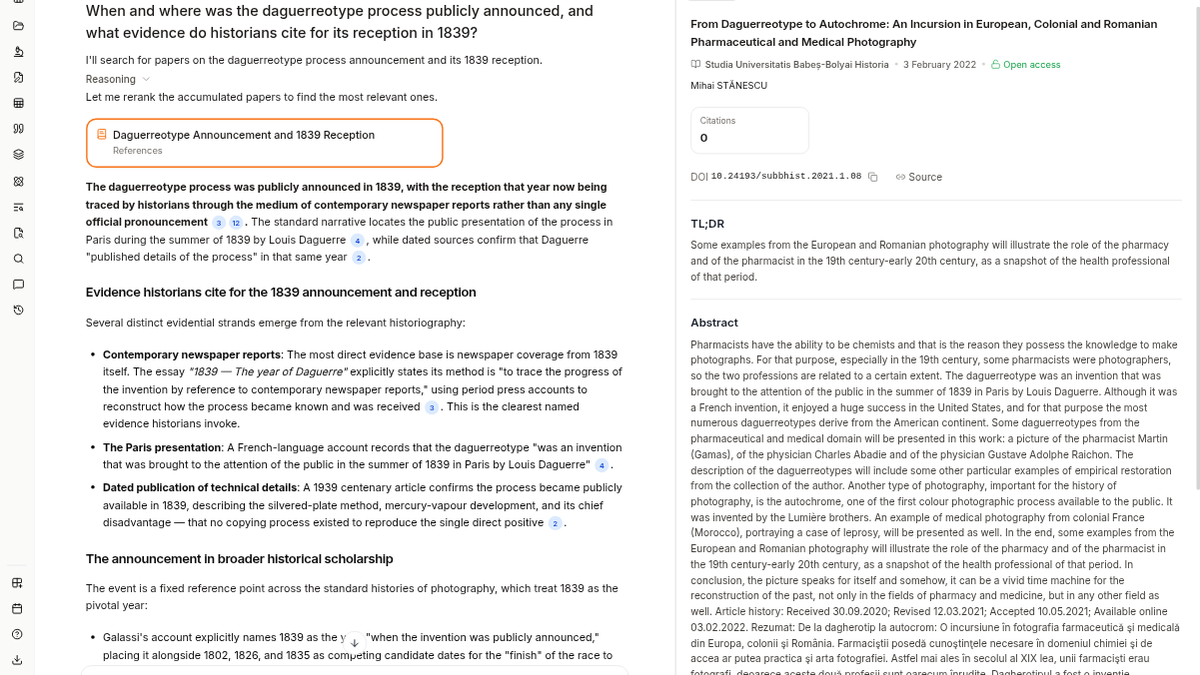
I signed up on free, asked Paperguide when the daguerreotype was announced, and got a Paris-1839 answer with numbered citations I could open. Then I tried to trick it into inventing an 1835 London patent. It refused. That combination is why this one gets four stars — and why the free credit story still bugs me.
The signup was email and a password, no Google, no card. Cloudflare's Turnstile sat on the form and auto-cleared without a picture puzzle. No verify email. A pricing modal and a RESEARCH50 coupon banner showed up immediately; I closed both. Under two minutes later I was staring at "Hello Researcher, What would you like to research today?" with AI Search selected.
The first suspect: ungrounded chat
Most AI research tools will talk about 1839 whether or not they have a paper. Paperguide's pitch is the opposite — every claim linked to a source. So I typed: "When and where was the daguerreotype process publicly announced, and what evidence do historians cite for its reception in 1839?"
It thought for a bit, then wrote that the process was publicly announced in Paris in the summer of 1839 by Louis Daguerre, and that historians mostly track reception through contemporary newspaper reports rather than one official text. Inline blue numbered cites sat on the sentences. A honesty note in the answer itself admitted that none of the papers it retrieved pinned the French Academy / Arago date. That note is the early clue. Keep it.
Opening the papers

I clicked through three of them.
Adamson, "1839 — The year of Daguerre," History of Photography, 1989, DOI 10.1080/03087298.1989.10441188. The in-app drawer matched the title. The Taylor & Francis page opened. It's a newspaper-report survey of that year — exactly the evidence strand the answer leaned on.
Nature's "A Hundred Years of Photography" at DOI 10.1038/143963a0. Real centenary piece. Plausible for process details.
Stănescu, "From Daguerreotype to Autochrome…," Studia Universitatis Babeș-Bolyai Historia, 2022, DOI 10.24193/subbhist.2021.1.08. Open access. The abstract literally says the daguerreotype was brought to public attention in the summer of 1839 in Paris by Louis Daguerre. Title match, claim match.
So the "will invent DOIs" suspect is gone for this session. The papers exist, the titles match, and at least two of them say what the answer used them for.
Planting a false patent
I planted a lie on purpose: "Did Louis Daguerre patent the daguerreotype in London in 1835, and was Talbot involved in that patent?"
Paperguide said no. French state acquisition in 1839, Arago's lecture on 19 August 1839, English rights going to Richard Beard, Talbot working a separate calotype patent. No 1835 London patent appeared in its sources, and it said so. That is the payoff of the earlier honesty note — the first answer left the Academy date soft, then the follow-up produced the date with the corrective history instead of inventing a patent to please me.
A saved paper, and a counter that won't move
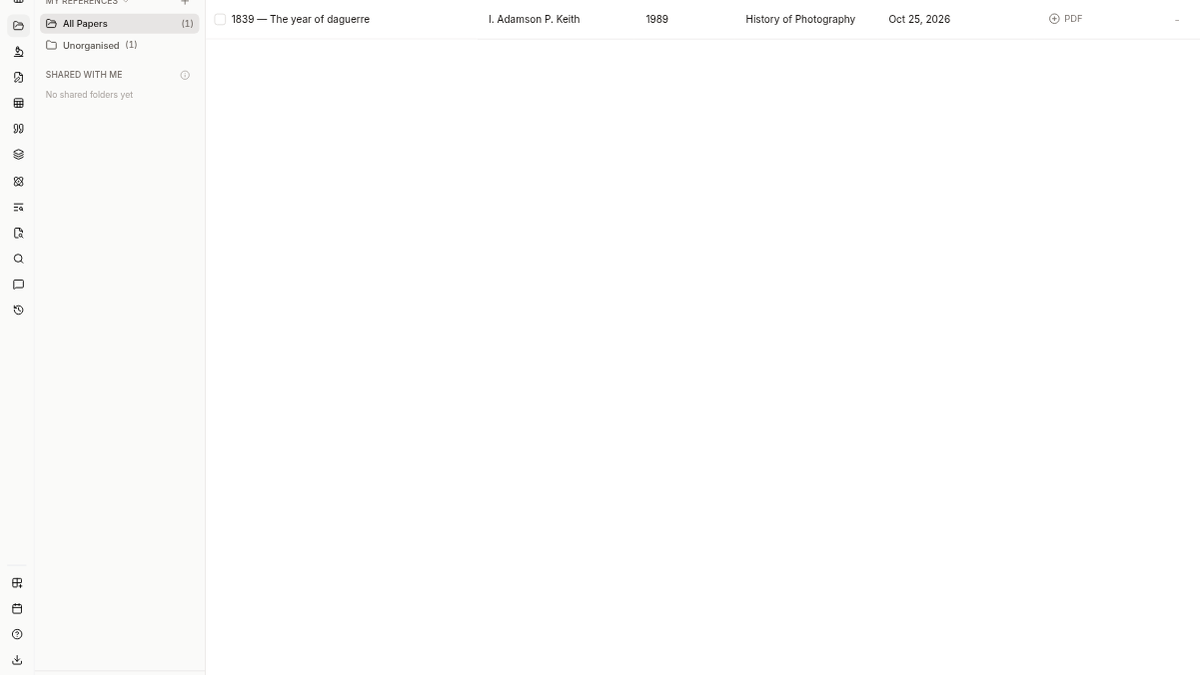
I hit My References on the Adamson paper, then navigated to /references/. It was still there under All Papers (1), Added Oct 25, 2026, PDF icon attached. So the "Reference Manager is vapor" suspect is out.
The credit counter is the odd one. Before the searches I had 1,500 of 1,500 AI credits and 0 of 20 AI Searches used. After two AI Searches: still 1,500 credits remaining, zero used — but AI Searches sat at 2 of 20, and daily AI generations at 2 of 5. Free marketing sells "1,500 AI credits per month" for Agents, Reports, and Writer. Search burns a separate limited quota. If you came for Search, the big number on the Free card is not the meter that moves.
What free actually costs
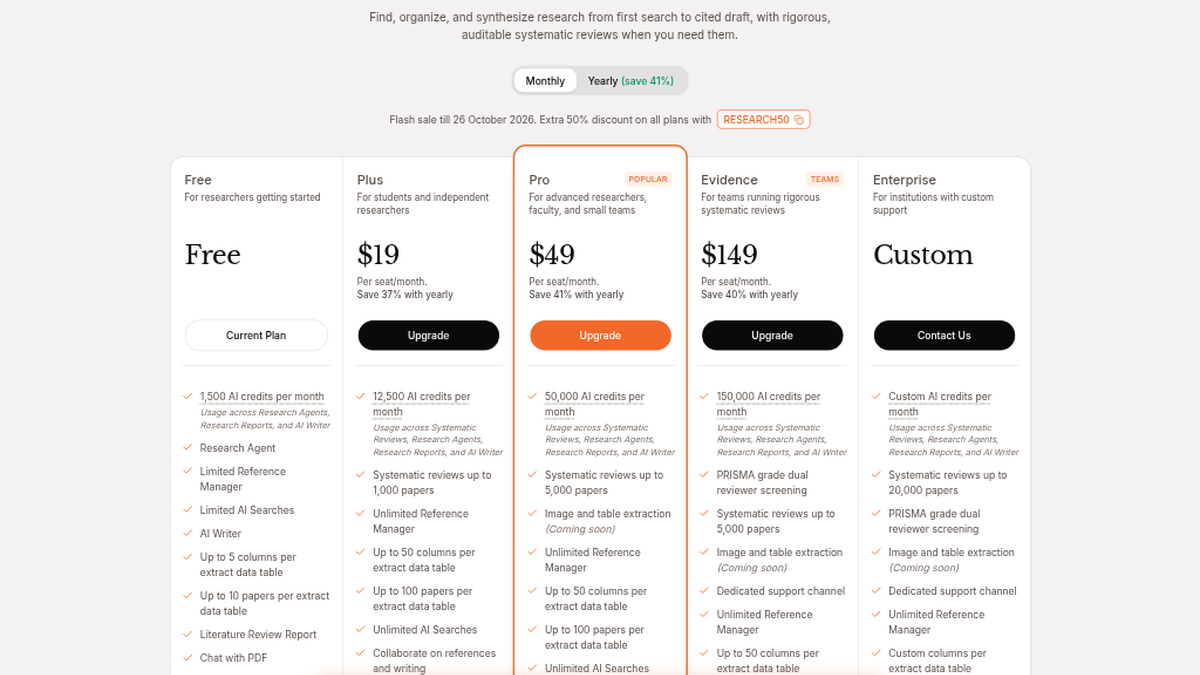
Pricing (yearly toggle, save 41%, RESEARCH50 flash sale running while I was there): Free is current plan — 1,500 AI credits/mo, limited Reference Manager, limited AI Searches, AI Writer, Chat with PDF, Literature Review and Deep Research Report, Zotero/Mendeley import. Plus is $12/seat/mo billed annually (12,500 credits, unlimited searches and Reference Manager). Pro $29. Evidence Teams $89. I didn't buy anything.
I didn't run Systematic Review, Extract Data, AI Writer, Chat with PDF on an upload, or a Zotero sync. Free Reference Manager also left some export/cite buttons grayed on certain titles.
If you need a cited answer on a history question and will open the papers yourself, Paperguide's free AI Search did the job — and it would not invent an 1835 London patent when I asked it to. If you need twenty-plus searches a month, a full bibliography export, or a credit meter that matches the Free card, the free plan is a short demo. More details and alternatives on Paperguide on ToolifyNav.
Final rating: 4 out of 5.
ToolifyNav Directory
Explore Paperguide on ToolifyNav
AI research platform for literature and systematic reviews that searches 200M+ papers with cited answers, manages references, extracts data into tables and drafts citation-grounded text.
Keep Reading
Related posts
SaaS Reviews
Jenni vs Paperpal: One Writes the Paragraph, the Other Fixes Yours
Jenni wrote me a cited paragraph on the daguerreotype and three of its four sources held up. Paperpal caught all seven slips I seeded in my own paragraph. Same $12 entry price, opposite jobs, and two free meters that run out differently.
SaaS Reviews
Jenni Review (4/5): Real Citations, Paywalled Bibliography
I asked Jenni for a cited paragraph on the daguerreotype. Every source it cited was a real paper, three of four actually backed their sentences, and a paraphrase took four seconds. The reference list itself is paywalled on free. Final rating: 4 out of 5.
SaaS Reviews
Paperpal Review: 7 of 7 Planted Grammar Slips Caught on the Free Tier (4/5)
I pasted an 86-word paragraph with seven planted grammar slips into Paperpal's free tier. It caught all seven, rewrote one sentence with Make Academic in about 2.5 seconds, and quietly charged 11 of my 200 monthly edits before I'd accepted a single fix.