Flashloop First Look: Faceless Studios, Claude MCP, and Steep Starter Credit Math
A pre-purchase breakdown of Flashloop’s multi-model video suite, dedicated Faceless and Storycraft studios, and official Claude MCP server—plus why a single 69,600-credit Seedance preview quote makes the $19 Starter plan tight before you even hit render.

Evaluation Snapshot (ToolifyNav First Look) Author: Leo Liang | Date: November 28, 2026 | Format: Pre-purchase UI, architecture & pricing breakdown What we inspected: Public Create Video composer, Seedance 2.0 prompt credit metering, Faceless Studio & Storycraft structure, published Claude MCP docs, pricing tiers Paid render completed: No (stopped at the mandatory sign-in / paid credit gate; no video exported) Rating: Unrated (pending paid output benchmark)
Most AI video generators still hand you a bare prompt box, charge per clip, and leave you to stitch scenes together in a separate editor. Flashloop pitches a more structured setup: a multi-model creative suite with specialized workflow studios for serialized content and an official Model Context Protocol (MCP) server for triggering renders from Claude or Cursor. Before paying for a subscription, I walked through Flashloop’s public video composer, studio architecture, and pricing rules to see what creators actually get—and where the credit math gets steep.

Upfront credit math: 69,600 credits for one 8-second preview
Opening the Create Video tab without an account lets you inspect the composer and see real-time credit quotes before committing to a plan. To test how the estimator prices a demanding shot, I pasted in an optical benchmark prompt ("A macro close-up of a circular polarizer filter rotating on an 85mm lens in golden hour light, revealing reflections disappearing from water"). The interface immediately surfaced the core controls: a duration slider (defaulting to 8 seconds), resolution toggles (480p through 1080p), speed options, and an active model badge set to ByteDance’s Seedance 2.0 (the workspace default, while Seedance 2.5 sits in higher tiers). The moment the prompt landed in the composer, the action button updated to an explicit quote: Generate 69,600 credits. Clicking it opened a mandatory Sign in to continue modal (Sign up or Log in), confirming there is no unauthenticated free sandbox clip.

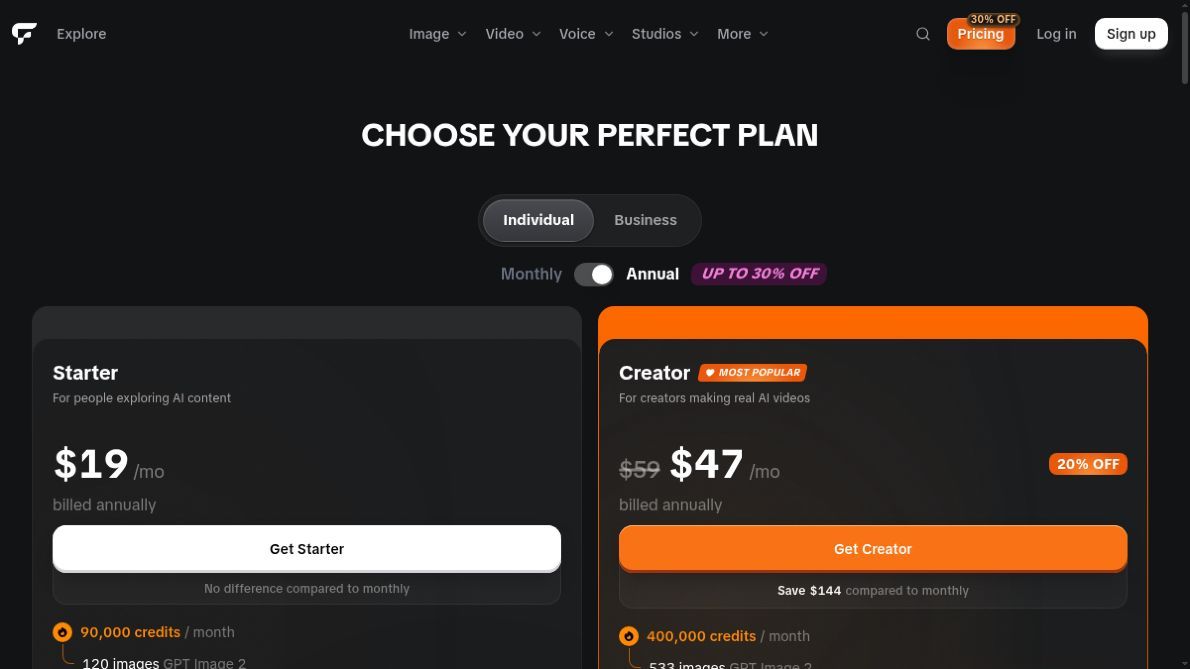
Seeing the exact credit quote upfront is helpful, but the ratio against the entry tier is jarring. On Flashloop’s pricing page (checked November 2026), the Starter plan ($19/month) provides 90,000 monthly credits. That means a single 8-second 480p Seedance 2.0 preview quoted at 69,600 credits consumes 77.3% of your entire monthly Starter allowance in one shot, leaving just 20,400 credits for the rest of the month. Flashloop’s published credit rules tighten that constraint further:
- No monthly rollover: Unused monthly plan credits reset at each billing cycle.
- Automatic refunds on failures: If a generation fails, those credits are automatically refunded back to your balance.
- Top-ups gated to Ultra: One-time non-expiring credit top-up packs are only available on Ultra plans, not Starter or Creator.
Dedicated studios: Faceless Studio and Storycraft
Faceless Studio
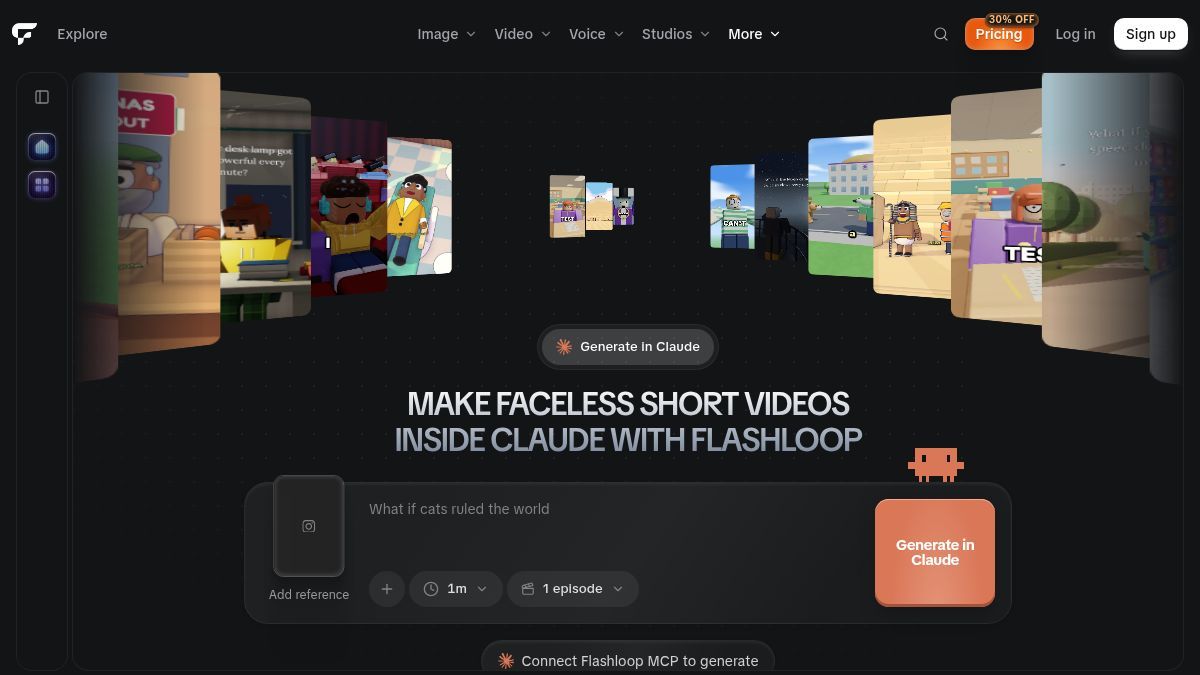
Where Flashloop tries to justify sitting above bare model wrappers is its studio layer. Faceless Studio is built specifically for episodic short-form vertical video (TikTok, Instagram Reels, and YouTube Shorts), organizing production into four stages: Scripting, Scene Generation, Voice & Music, and Final Assembly. It advertises support for up to 4 continuous episodes per setup alongside 70+ style presets (such as 3D Explained, Block Story, Comic Realism, Toon Satire, Toy & Toon, and Cinematic 3D). On paper, that addresses a major pain point in serialized shorts, though whether character and style consistency actually holds across multi-episode exports remains to be verified in a paid render test.
Storycraft Studio
Beyond vertical video, Storycraft Studio targets illustrated books, comics, and manga. Its pitch over standalone text-to-image generators is continuity tagging—allowing creators to anchor recurring characters, locations, and key objects across multi-page layouts with built-in style presets like Watercolor, Anime, and Digital Ink.

Official Claude MCP integration
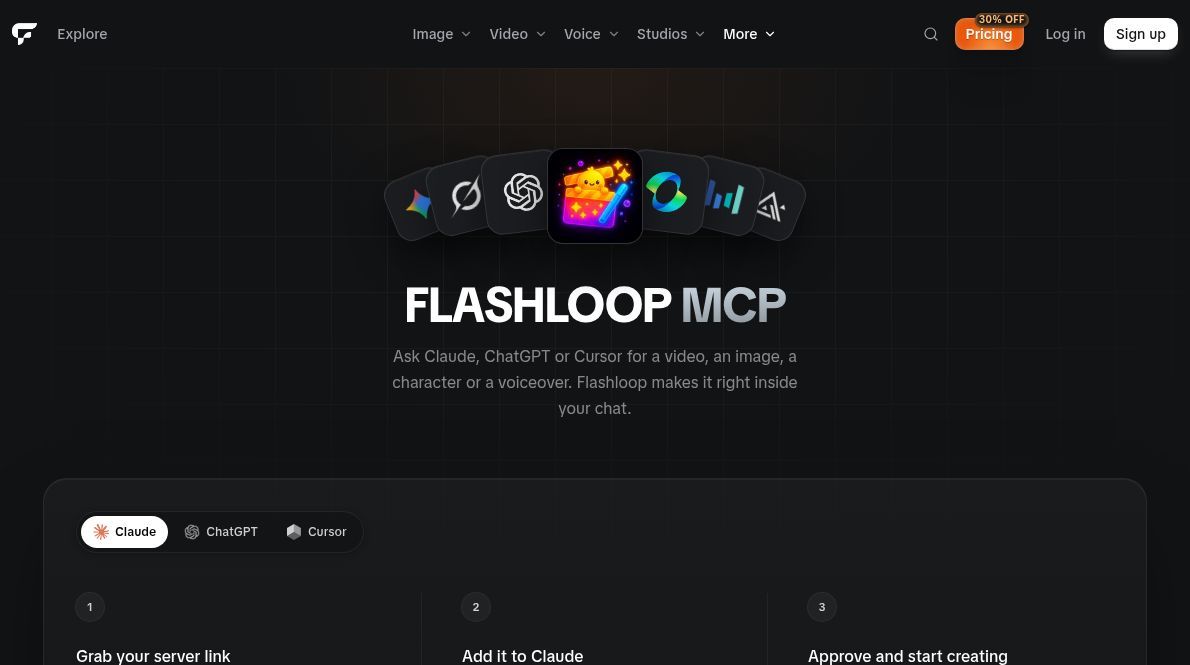
Flashloop’s most distinctive technical bet is exposing the platform as an official Model Context Protocol (MCP) server at mcp.flashloop.ai/mcp. According to Flashloop’s documentation, connecting the endpoint to MCP-compatible clients—including Claude Desktop, Claude Code, Cursor, and ChatGPT—lets you trigger video, image, and voiceover jobs directly from a conversation without switching browser tabs. Setup carries no extra connector fee (generations draw from your regular Flashloop credit balance and sync back to your library). One practical caveat: given how steep per-clip credit consumption can be, running agentic render loops without explicit spend guardrails could drain a monthly balance in minutes. Note that we reviewed Flashloop’s published MCP endpoint and documentation rather than executing a live paid MCP render loop.
Multi-model roster and plan tiers
As of November 2026, Flashloop advertises an aggregated roster under one account and credit pool, including Google Veo 3.1, Kling, ByteDance Seedance (Seedance 2.0 in the entry composer up to Seedance 2.5 on higher tiers), OpenAI GPT Image, and Gemini Nano Banana. Access and monthly headroom scale sharply across tiers:
- Starter ($19/month · 90,000 credits): Entry-level access to standard models with no top-ups. Best treated as light exploration or image/audio budget rather than heavy video iteration.
- Creator ($59/month, or $47/month billed annually, saving $144/year · 400,000 credits): Unlocks higher-tier video models (including Seedance 2.5 and Kling) and broader studio workflows; still does not include one-time top-up packs.
- Ultra (1M / 2M / 3M monthly credits): Built for agencies and active production teams, and the only tier family that supports non-expiring one-time top-up packs.
Who should consider Flashloop—and who should wait
Worth shortlisting if you:
- Produce recurring faceless shorts, ad variations, or illustrated stories and want structured studio templates alongside multi-model access under one bill
- Already script workflows inside Claude Desktop, Claude Code, or Cursor and want an official MCP endpoint to trigger media generation
- Have budget for Creator or Ultra tiers to consolidate separate image and video subscriptions
Hold off or budget carefully if you:
- Want a low-cost $19/month video playground to test dozens of experimental prompts
- Need rollover monthly credits or pay-as-you-go top-ups without upgrading to an Ultra tier
- Require verified output benchmarks first—review sample renders or wait for a full paid render evaluation before committing to an annual plan
What we haven’t tested yet
To keep this first look transparent, we have not yet evaluated:
- Actual video output quality, lighting physics, or motion consistency from Seedance, Kling, or Veo inside Flashloop
- Real-world render latency, failure rates, and multi-episode visual consistency in Faceless Studio and Storycraft
- Live tool-calling reliability via
mcp.flashloop.ai/mcpinside Claude or Cursor - iOS and Android project syncing, Topaz 4K upscaling, or multi-seat workspace credit sharing
We will update this breakdown with sample renders and a scored verdict if we run a paid test cycle. You can also track plan updates and model changes on the Flashloop listing on ToolifyNav.
ToolifyNav Directory
Explore Flashloop on ToolifyNav
Flashloop is an AI video and image generator for creators and marketing teams. Describe what you want, or start from a photo or clip you already have, and Flashloop turns it into a video, an image or a short series.
Keep Reading
Related posts
SaaS Reviews
Consensus vs Connected Papers: An Evidence Meter or a Citation Map? (Tested)
Consensus turned a clinical fasting question into a 20-paper consensus meter and extracted effect sizes in 13 seconds — after gating search behind email verification. Connected Papers built an interactive citation graph for Vaswani et al. in three seconds with zero signup and free BibTeX export — but cannot answer a yes/no question. Both rated 4/5. Here is how to pick between evidence synthesis and neighborhood mapping.
SaaS Reviews
Hemingway Editor Review: Post-Graduate Sludge to Grade 12 in Seconds, Hidden Sentence Math, and Export Behind a Paywall (4/5)
I pasted 112 words of dense optical filter technical copy into Hemingway Editor Plus to see if its AI rewrite lives up to the iconic web editor. It instantly flagged my 48-word run-on sentence as Post-Graduate sludge, split it into three clean statements, and dropped the readability score to Grade 12. But while the free web app stays open, file imports, exports (Word/HTML/Markdown), and target grades are paywalled behind $8.33 to $12.50/mo, and credits are metered strictly by sentence rather than word counts.
SaaS Reviews
Banani Review: A Leica-Style Lens Bench in 45 Seconds, a Surprise Pricing Pop-Up, and Paywalled Figma Exports (4/5)
Banani generated a multi-screen dark-mode camera lens filter directory in about 45 seconds, asking sharp aesthetic questions like Leica versus Peak Design before rendering. The prototype canvas is responsive and detailed, but hitting a surprise pricing modal before your first render, paywalled Figma exports, and an 80% starter quota drop keep it at 4/5.